
November 1, 2025
I wish to explain what I judge to be the factor that has obstructed progress in interactive storytelling. The problem is so serious that I fear that interactive storytelling will remain for many years an unrealized ideal.
My pessimism is not motivated by plaints about the deficiencies of hardware; it arises from a problem identified more than 60 years ago by a British savant by the name of C.P. Snow. He called it “The Two Cultures”.
Snow’s observation was that, in the wake of World War II, intellectual culture had bifurcated into two mutually antagonistic subcultures: science & technology on the one hand, and the arts & humanities on the other. The scientists & engineers were wallowing in government money because science & technology had won the war. Meanwhile, the arts & humanities struggled along with the usual miserly funding. The ever-increasing specialization in science & engineering required more and more time devoted to studying the expanding body of knowledge, depriving the scientists & engineers of time to do more than dip their toes into the ocean of wisdom provided by the arts & humanities.
Meanwhile, the arts & humanities community turned its back on the sciences, which had suddenly become immensely more complicated.
Both sides excused their ignorance of each other with slanders. To the scientists & engineers, arts & humanities people were “basket-weavers”; the arts & humanities people retaliated by labelling the science & engineering people “propeller-heads”. The cultures drew further and further apart.
The problem was most severe in America; in Europe, it’s harder to ignore the arts & humanities when you’re surrounded by some of humanity’s greatest works of art. But America had the most money, so it led the way in many fields.
The mutual disdain that the two communities felt for each other was seldom a serious impediment in either area. Rocket scientists need not know anything about Shakespeare, and novelists have no need to grasp the Second Law of Thermodynamics. So each community remained happily safe in its little intellectual fortress.
Then one day, video games were born. Their nativity was on the science & engineering side of the wall, but as an entertainment form, it was obvious that they needed the contributions of the arts & entertainment people.
That never happened, because the two communities had drifted so far apart that they simply could not collaborate effectively. They spoke different languages and thought differently. Moreover, their mutual ignorance prevented productive interaction. The science & engineering people based their understanding of storytelling on Star Wars; the arts & humanities people thought of computers as inscrutable boxes capable of wondrous black magic.
Ask a video game designer to list some of the great storytellers in history and they might mention Shakespeare, Steven Spielberg, and George Lucas. Ask them about Homer and they’ll light up in recognition and tell you about The Simpsons. Hemingway? Wasn’t she some actress? Hitchcock? Um… Er… And don’t even mention anybody who didn’t use English.
It’s just as depressing talking to an arts & humanities person. C++? That’s the best grade they got in Elementary Science 101. The Cloud? It’s up in the sky. Benchmark? Um… something made with a big paintbrush?
The failure of the two cultures to work together is not for want of trying. Because there’s so much money in the industry, people have been trying to graft the two sides together for decades. There have been hundreds of such collaborations, combining brilliant artists with programming experts. Most of them end up looking like this:

All very impressive, but it doesn’t work.
While it is possible for technical people to learn art, my experience is that the transformation required to accomplish this is too fundamental a personality challenge to work. While many artists have demonstrated the ability to absorb basic programming concepts, they always balk at developing the mathematical skills necessary for algorithm design.

Thus, the Holy Grail of interactive storytelling lies beyond our reach.
What about Artificial Intelligence?
Yes, yes, artificial intelligence is the greatest thing since video games, soap operas, and the steam engine. AI will change everything, ushering in a brave new world of ease and plenty. AI will balance the federal budget, engender a stable government in Italy, and bring about world peace. Right?
Well, no. I’m not the first person to express skepticism over the potential of AI. For all I know, by the time I publish this essay, the AI bubble will have burst and Sam Altman will be standing at the side of the road holding a sign saying “Will program AI systems for food”. Still, I have to admit that AI systems have done some really impressive stuff. I used one of the older AI systems to build some of the imagery used in this essay — but only after I gave up trying to train a tiger to sit on the back of a shark.
The fundamental flaw with the notion of using AI to make art is that art is an expression about the human condition. No AI system can ever experience what we humans experience; it can only copy expressions from real people. But an absolutely fundamental requirement of art is that it be original and unique. I prompted an AI system with “The Mona Lisa, only better”, and got this:
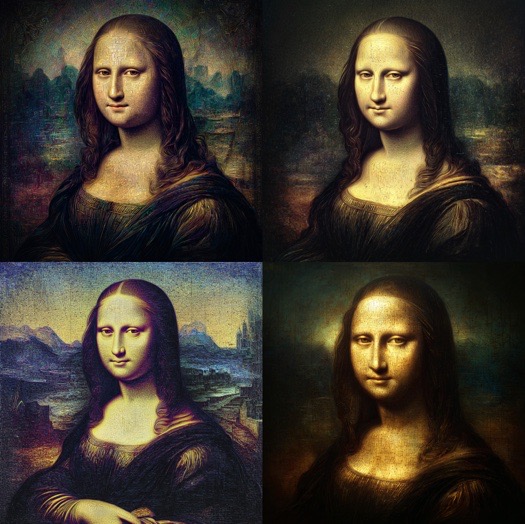
This is not art. So then I prompted the AI system with “a formal portrait of a lady which is better than the Mona Lisa” and got this:
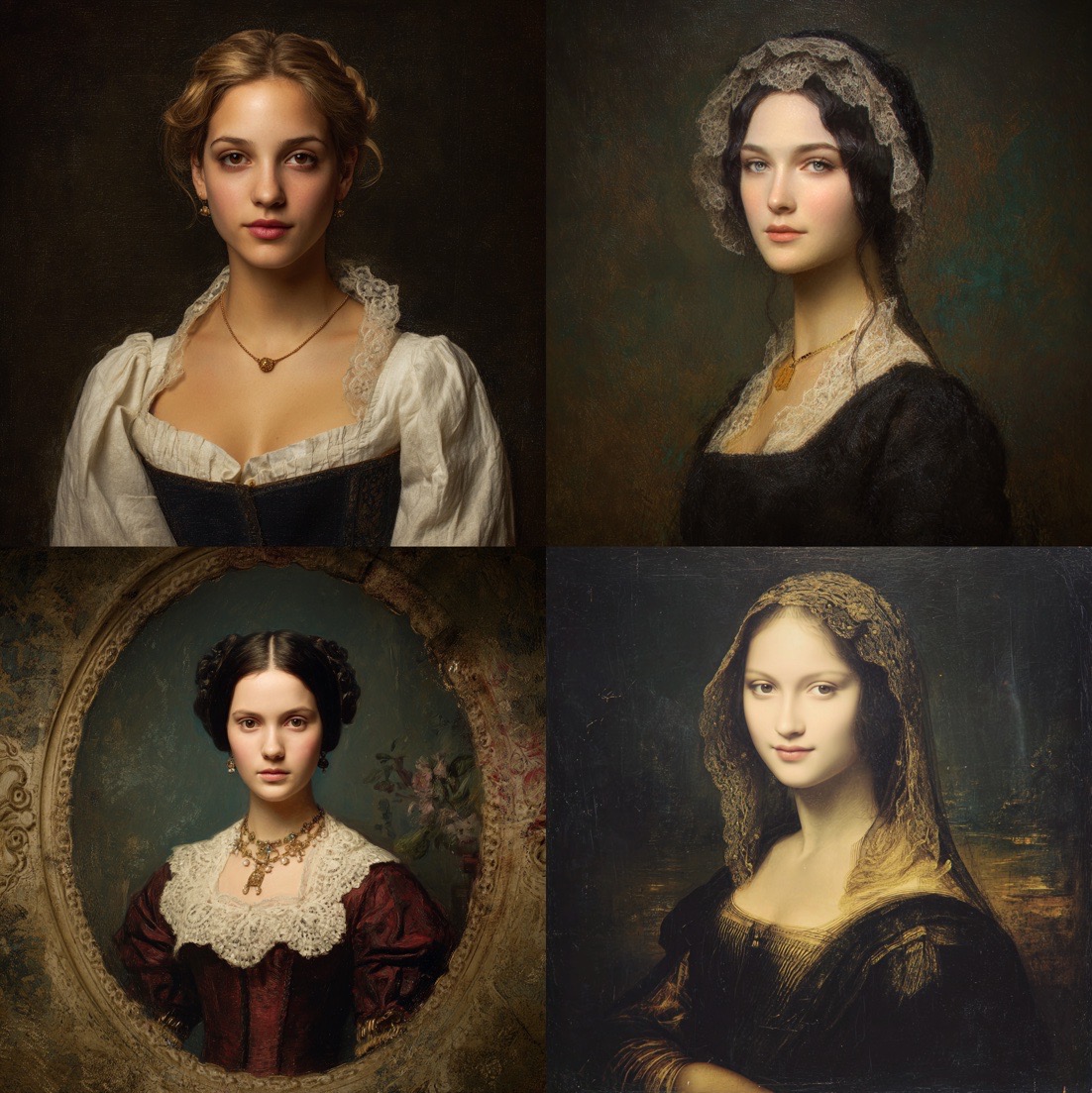
Neither is this art. These are pretty pictures, to be sure, but they don’t say anything about the human condition. The Mona Lisa is a powerful statement about the mysterious allure of a young woman. These are merely pretty pictures.
Perhaps I was using the wrong starting point. So I tried this prompt: “an artistically superior version of the Statue of David”
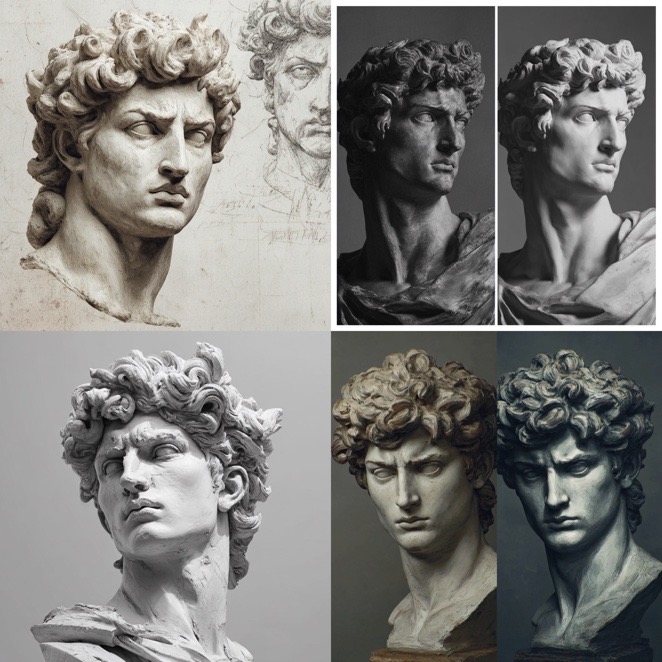
Arrrrgh! This completely misses the essence of the Statue of David; it shows only his head. David’s body — its posture, its stance — is just as important as his head, but the AI doesn’t know that. It just mindlessly reproduces the most common representations of the Statue of David that it can find.
What can be done?
The fundamental problem is that only a handful of people are willing to take the necessary steps to learn how to build effective interactive storytelling. I place more blame on the artists than the programmers here; while programmers have no tradition of exploring other fields, artists have a long history of exploring other fields to better their art. The most salient example is the study of anatomy that occupied so many painters and sculptors during the Renaissance.
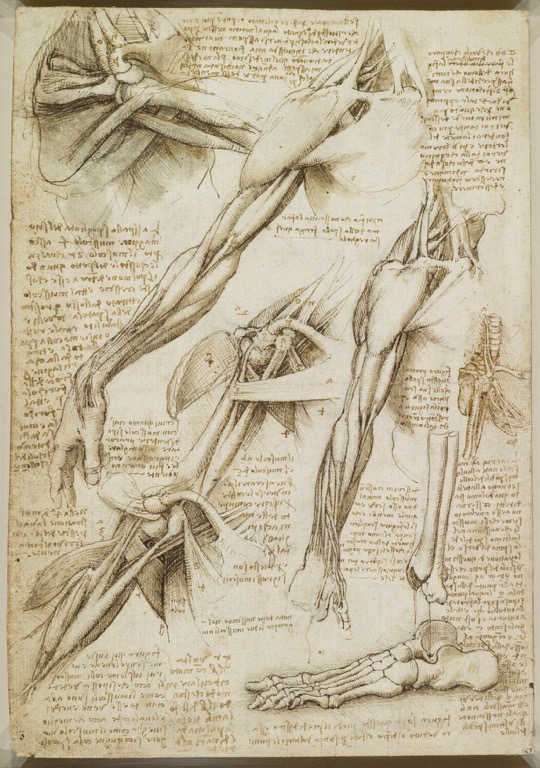
Back then, there were no preservatives; in the hot Italian climate, dead bodies quickly began to rot. The stench must have been overpowering, but serious artists held those noses and picked through dead muscles, skin, and bones in order to understand how to properly depict the human body. Yet aspiring interactive storytellers quail at the thought of revisiting their high school algebra. Would that modern artists had the same grit as the Renaissance artists!
In their defense, I must point out that there are so many promising diversions. Interactive fiction has long attracted prospective interactive storytellers, promising an easy path to success. That promise has proved illusory; while some of the development systems for interactive fiction provide for mathematical algorithms, the stylistic standards of the community shy away from mathematics, emphasizing simple boolean metrics or, at most, basic integer counts. Algebraic manipulation of values is avoided. Interactive fiction has been with us for nearly 50 years now and it has yet to produce a genuine work of true interactive storytelling.
The tool shapes the hand of the user. “When you’ve got a big enough hammer, everything looks like a nail.” The tools for interactive fiction are so highly developed, so well-polished, that they amount to very large hammers. One would think that, after so much effort by so many thousands of talented people without a solution to the problem, people would start exploring other approaches. But so far, people seem happy to keeping pounding away at interactive fiction.
We should not overlook the academic world; people there have been doing impressive work. Yet, although their work yields astounding results, what I have seen strikes me as robotic. Their robot-characters say and do clever things, but they just don’t strike me as dramatically compelling. Perhaps I have missed something in the latest work. It lacks feeling.
The system I built for Le Morte d’Arthur is embarrassingly simple; a mostly linear structure whose ending depends on the player’s decisions through some 300 events. Yet, it works; feedback from the players who have the gumption to stick with it all the way to the end is enthusiastic. It has a great many flaws and clumsy moments. I have been promising myself to prepare a second edition someday to clean out the screwups. I’ll get to it someday. Really, I will. No kidding. Someday real soon now.
The scheme I used for Le Morte d’Arthur will not produce what I judge to be full-blooded interactive storytelling. It is interactive storytelling, to be sure, but interactive storytelling at a less powerful level than I think is ultimately possible. Its greatest value, I think, is as a steppingstone to the Holy Grail.
We don’t need teams of tigers and sharks. We need tigers who are willing to shed their fear of the water and learn to swim.