
September 10th, 2025
I claim that any civilization anywhere in the universe will have limited capacity for change. I suppose I could argue that the truth of my claim is self-evident — who would insist that there must be at least one civilization with infinite capacity for change? I think I can present background information that will make my claim easier to understand.
We already have a model to work with, a model that provides us with must useful food for thought: the adaptive systems used by living creatures here on earth. We have two such systems.
Genetic Adaptation
The first system is genetic. Our DNA is subject to random variations that generate randomly different descendants. Let’s consider some details about that system from a high-level theoretical vantage point. There are two fundamental variables that determine its overall effectiveness: frequency and magnitude of change.
Frequency of change is reflected in how often we suffer genetic change in our reproductive efforts. There are, as I understand it, a number of factors contributing to genetic change. We know that exposure to radiation can increase the rate of genetic change. High-energy particles (typically alpha particles or gamma rays) can rip through a cell, ionizing molecules. Those ions can then chemically attack DNA molecules, altering them. There are a variety of other processes that can alter DNA. These events are surely random.
A reproductive cell (ovum or sperm) that has suffered damage to its DNA will engender a creature with a fundamental flaw in its organization. There are about 3 billion nucleotides in human DNA, so one damaged nucleotide won’t turn a baby into a bug-eyed monster with long claws and a hunger for human flesh. The random changes in DNA are seldom large enough to make an observable change in a creature. After all, cells have systems in place for repairing most damage to DNA. Most genetic change takes place among many individuals whose insignificant changes just happen to combine in a manner that produces a significant change.
What is striking is that most creatures on earth have the same basic capacity for responding to change, determined by the rate of change of DNA triggered by background radiation. However, we measure this capacity by the number of generations a species must go through before a major change in its behavior takes a large portion of its gene pool. The first experiment investigating this was the E.Coli long term evolution experiment. This demonstrated an ability in these simple bacteria to adapt to a significant change in their environment in some tens of thousands of generations. Another data point we have is the final evolutionary step of our own species, Homo Sapiens, which appears to have taken some tens of thousands of generations to effect.
Genetic adaptation to change has proven to be quite effective. The earth has undergone a great deal of catastrophic change, yet life has endured all that change and adapted to new environments. All in all, the earth’s biosphere has been shown to be quite resilient.
Cultural Adaptation
One species, Homo Sapiens, developed a far superior system for adaptation: culture. The simplest way to understand the significance of culture is to think in computer terms. Genes are the hardware for species, while culture is software. Culture is really just a set of rules for behavior. By developing culture as the software for dealing with the world, Homo Sapiens was able to adapt to any environment. This allowed it to spread all over the planet, and later to develop advanced technology.
But even cultural change has its limitations. Genetic change requires some tens of thousands of generations to properly adapt to a major change in the environment; cultural change is immensely faster, requiring only a handful of generations to effect a proper adaptation. So long as change is so slow that it adaptation within a few generations — say, a hundred years — cultural change is an adequate adaptive measure. But once our society starts undergoing massive change in less than a century, Homo Sapiens is unable to adapt quickly enough.
The Fundamental Limit
There is a fundamental constraint upon any system’s ability to adapt; it arises from the necessity of system optimization. Every system achieves equilibrium with its environment by optimizing its utilization of resources. Any system that expends resources to expand a capability that delivers no benefit wastes those resources and will fail in competition with a more closely adapted system.
For example, consider a call for proposals to build a nuclear power plant in Nevada. Two companies submit proposals. One company’s design is conventional; the other design includes added walls and breakwaters to protect the power plant from tsunamis. This latter proposal costs more than the first proposal and will surely fail to be selected. Too much capability is just as bad as too little capability.
Another example, this one from biology: imagine an animal species that is well-adapted to its environment, and one day a genetic mutation appears that enlarges the stomach. Now, the species is already well-adapted, meaning that a larger stomach, while permitting it to digest a greater intake of food, doesn’t provide any significant benefit. It might, in combination with other mutations, permit the expansion of the species into a better environmental niche, but by itself does not permit such an expansion. The larger stomach, however, consumes additional resources and increases the weight of the creature. Thus, this genetic mutation reduces the animal’s efficiency and will not expand into the gene pool.
Here’s another example: Joe runs a restaurant. He has a cousin who is allergic to any food containing oats, and Joe is sympathetic to his cousin’s plight, so he creates several special “oat-free” dishes for customers who share this rare ailment. Sadly, there are very few such people, and so Joe ends up stocking special ingredients that he rarely uses, and teaching his cooks how to prepare his special dishes. Those expenses cut into his profits, so that Joe ends up losing money and eventually he has to close his restaurant.
The point here is that any system possessing capabilities that don’t contribute to its effectiveness is actually LOSING effectiveness because it is wasting resources on those unnecessary capabilities.
Now let’s apply this principle to the concept of a systems ability to change in response to changes in its environment. Let’s consider three different environments (Blue, Green, and Red) with three different rates of change in some important variable, such as temperature or rainfall:
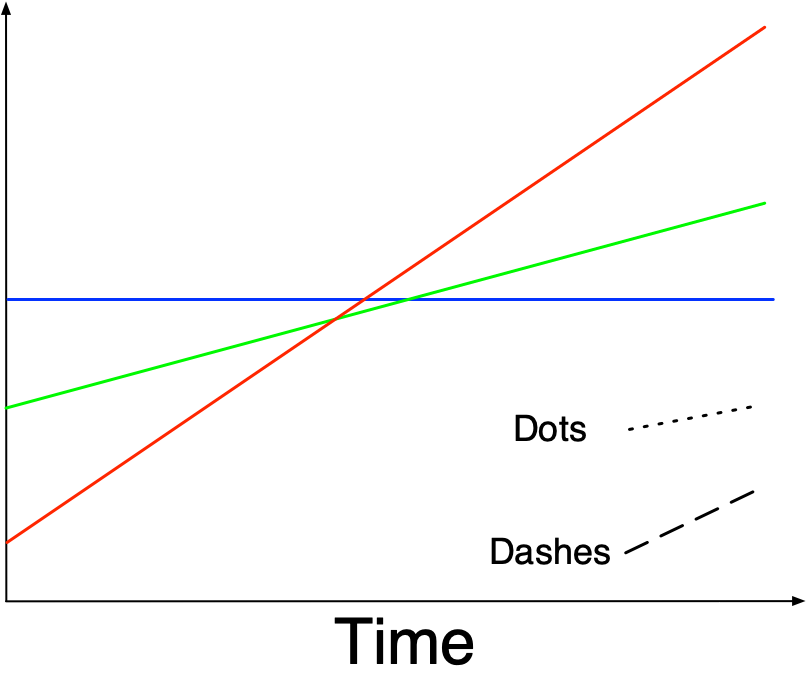
The Blue environment is stable; it is not changing. The Green environment changes slowly, and the Red environment changes rapidly.
Now consider two animal species, which I’ll call Dots and Dashes. The Dots are capable of handling slow change, while the Dashes have faster ability to change. However, we must remember that the Dashes’ feature allowing rapid change consumes more resource than the Dots' feature allowing only slower response to changes in the environment.
Thus, the Dots will outperform the Dashes in the Blue environment, because they’re wasting less resource. But in the Green environment, the Dots will not be able to keep up with change, and they’ll go extinct, while the Dashes will have no problem coping with the Green rate of change. But in the Red environment, change will come too fast for even the Dashes, and they’ll go extinct.
But now consider the situation that technological civilizations face, in which the rate of change itself changes:
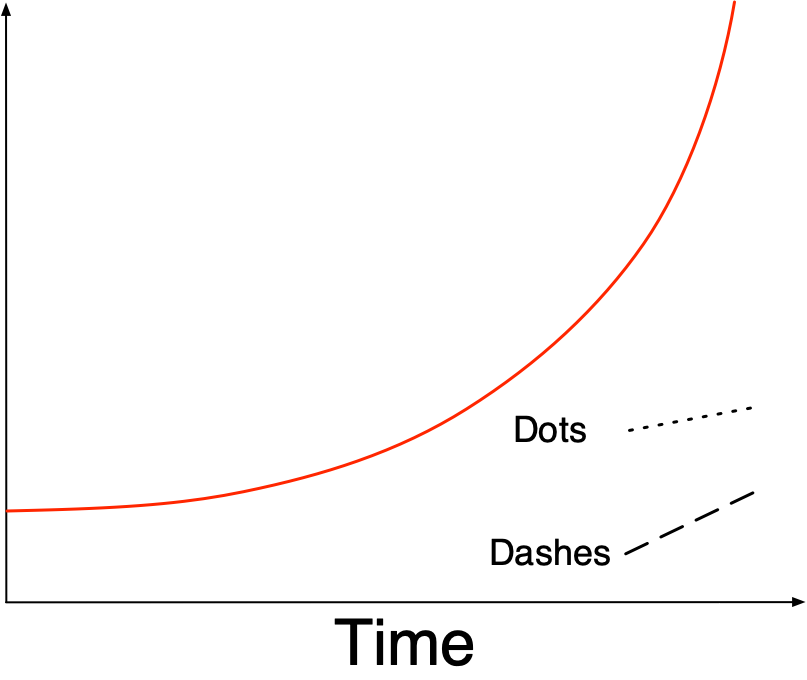
In this situation, both the Dots and the Dashes are doomed to extinction. No matter how adaptable the Dashes are, they must eventually face a rate of change greater than they can handle.
Ah, but what if there were another species whose ability to change was itself changeable? What if, for example, it had cells that had natural mutation rates that could be increased or decreased as needed? That’s certainly conceivable, but I don’t think it’s plausible, because systems cannot foresee the future. Suppose that you have a species that is adapted to its environment. Then a mutation comes along that enables this powerful new “variable mutation rate” capability. How would that mutation benefit its owner? If the rate of change of the environment is fairly stable, then the “variable mutation rate” mutation would be a burden on the species, and would end up disappearing from the gene pool.