
We’ve had books since writing was invented, but there were precious few books in early years because each and every book had to be written by hand. Imagine yourself copying an entire book onto paper by hand. Yuck! Hence, it was a big deal when Gutenberg invented the printing press in 1453. Printing presses started popping up all over Europe, and within a century there were hundreds of thousands of books. The price of books plummeted and suddenly lots of people were able to read books. This was one of the major leaps in human progress; books made possible an explosion of knowledge; surely our civilization would be much more primitive were it not for books.
But times change, and books are obsolescent. I really hate to admit this; I recall just 15 years ago warning students that the total amount of knowledge available on the Internet was far less than what was available in books. I cherish books; my library has more than 3,000 books, all nonfiction, covering a huge range of subjects. I read the best books a second or even third time, because what you learn from a book depends on how much knowledge you have when you read it. Reading a book twenty years after you first read it offers new realizations.
Every night I get into bed and grab one of the small pile of books I keep at my bedside and read it. I devote an hour to reading before bedtime. I’ve been doing this all my life. I read books when I was a kid; I recall my dad once coming into my bedroom at 3:00 AM to find me reading; he urged me to go back to bed. I still remember sitting in the back of our station wagon as we drove from Texas to our new home in California, reading Tom Sawyer.
I myself will never stop reading; the pleasure of the act of reading is too deeply embedded in my brain. But I can no longer urge young people to read books — at least, not with as much certainty as I once did.
The other day I read a story in The Economist about Elly Ntonde, a young man in Budondo, Uganda, studying for his exams. His village has no paved roads, no running water, and only occasional electricity. He was confused over a critical point that his textbook did not explain to his satisfaction. So he used his cheap mobile phone to access ChatGPT and ask his question. It took a few seconds for ChatGDP to provide him with a good answer. This fellow lives far from any decent library or bookstore, yet he has access to most human knowledge via his cellphone. Why, he could even read this essay!
The Internet, as digested by Large Language Models like ChatGPT, is replacing books as the primary source of knowledge for most people. Three attributes of the Internet are responsible for its superiority.
Fast Access
Imagine yourself in the Library of Congress, the largest library in the world, with complete access to everything stored there. What an opportunity! But alas, how can you find what you’re looking for? You can consult the electronic directory, but it provides only broad subject areas, book titles, and authors. Suppose you want to learn about the most idiotic military blunders in history. The perfect book for you is “From the Jaws of Victory”, by Charles Fair — but it would not be possible to find it from the catalogue at the library. Perhaps someday they’ll install a Large Language Model specific to the library allowing you to ask “What is a good book about the most idiotic military blunders in history?” — but it could work only after they have fed the entire contents of every book in the library into their AI system. That won’t be happening soon, if ever.
The fastest way to get the information you want is to ask an LLM like ChatGPT. You can have your answer in seconds. That in itself makes the Internet immensely superior to books.
Complete Access
It wasn’t long ago that the Internet was just as inscrutable as any library. It was a gigantic, random collection of fascinating material — it was impossible to become aware of some of its treasures. For a long time, Wikipedia was the best overall source of information about the world, but Wikipedia offered only short snippets of information, not the kind of in-depth knowledge that a book contains. There was no way to know about the brilliant essays and deep knowledge squirreled away on this website. Oh, the tragedy of it all!
But nowadays it’s easier to get to almost anything you would want. Do you have an old tractor that you’d like to keep in good repair? Just zip over to yesterdaystractors.com. Oh, it’s really old Honda motorcycles that command your attention? No problem — vintagehondatwins.com/forums/ has a crowd of enthusiastic experts ready to answer your every question. Butterflies? Well, of course, just go to butterflywebsite.com. Rutabagas? epicurious.com/ingredient/rutabaga has a bunch of recipes, but, sadly, nothing about chocolate-covered rutabagas. Whatever your interest, there’s a website out there for you.
It is true that books still retain the edge when it comes to highly specialized information, especially some academic information. So far.
Permanence
This may surprise you, but I have come to the conclusion that information on the Internet will likely be accessible longer than information in books. All books eventually go out of print; a website remains accessible for as long as the monthly payments are made, which can be forever. I have a large library of Erasmus books, most of which are out of print. It took me years of scouring bookstores to assemble my collection, and there are still some books that I just cannot find anywhere.
Hypertext
This is a huge advantage for web pages. Knowledge does not exist in isolation; every bit of knowledge rests on other bits of knowledge. This truth is most apparent with dictionaries, which perforce define words using other words. But nobody defines the “foundation words” that need no definition; the lexicographer must assume that anybody consulting a dictionary already knows a goodly collection of simple words. Then there are impish definitions, such as Samuel Johnson’s definition of a net: "Any thing reticulated or decussated, at equal distances, with interstices between the intersections”.
All knowledge conforms to this principle, hence any statement of truth necessarily refers to other truths. Books sometimes use footnotes to expand upon their statements, but it’s not much use to find a reference to, say, coprophagy accompanied by the footnote “See Crawford, Silly Obscure Words and Phrases, Peter Piper Press, 1987” But a webpage can simply link the reader directly to another web page explaining the concept. That’s a superior solution.
The hypertextuality of the web confers another advantage: “bite-sizedness” — breaking a big subject down into smaller, easier-to-digest pieces. If you buy a book, you are making a commitment to read the whole damn thing, when it is likely that only some portion of the material will be of interest or use to you. If, for example, you purchase a book of recipes, you’ll have to skip over all the stupid recipes for rutabagas to get to the recipes you actually want. But a website of recipes, such as epicurious.com, allows you to quickly skip over the nonsense and get directly to the good stuff.
Yet bite-sizedness in no way impedes the publication of big ideas. I have an entire hyperbole on this website, The History of Thinking. Its 81 webpages include a great deal more material than you would find in a book 81 pages long. It contains numerous crosslinks as well as links to outside sources.
Color, Sound, and Video
Just last night I was reading Stephen Jay Gould’s delightful book, Hen’s Teeth and Horse’s Toes. Here’s a photograph from the book, taken by Duncan M. Porter:
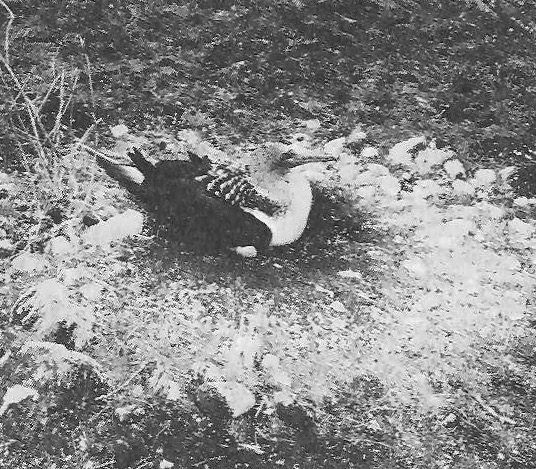
I scanned this photograph at fairly high resolution, yet it’s not quite clear. Here’s a photo I found on https://birdfact.com/birds/blue-footed-booby:

In books, you get crummy black and white images; on webpages, you can have high resolution and full color. It costs a lot of money to print full-color images in books; it costs next to nothing to include such images on websites.
But there’s more! A website can also contain sound and video — but I’m using an ancient website editor that just refuses to upload my demonstrative video. Dirty ricklefricks!
Editability
Once a book is published, it’s done. You can’t change it. If you want to include new material later, your only option is a second edition, which makes sense only if the first edition was a commercial success.
But a web page can be edited at the drop of a hat. You can embellish it with new imagery, change the text, add more material, or add completely new web pages expanding on ideas sketched out in the original page. I launched this website in 1997, I think, and I have been adding to it ever since. What was originally a handful of pages has grown into a complete history of my ideas. I’ll provide for its permanence in my will and people will be laughing at this swill far into the future.