
August 31st, 2025
In 1970, Alvin Toffler published “Future Shock”, in which he pointed out that the acceleration of change in our society would induce a psychological stress that he called “future shock”, with many ramifications for our future. I was unaware of Toffler’s work when I wrote this essay; I stumbled upon it only while conducting followup research. I address his book on this page.
In 1978, the BBC aired a television series starring James Burke. It was called “Connections” and, in ten episodes, it showed how technological progress was often a matter of accidents or coincidences. The most common observation was that a technological advance in one area would often later lead to a discovery in a completely different field. You can see the entire series here:
https://www.youtube.com/playlist?list=PL5HjoPOFFC56enV6cW1zqRvXyY6pNm8cq
Network effects of technology
Technology enjoys something like a network effect. A network effect arises when you have multiple interacting entities. The more entities that interact, the more interactions you can get.
Here’s the case in which you have just three elements to your system. It permits only 6 interactions among the elements.

But if you add just one more element, you double the number of possible interactions.

And if you increase the number of elements to just six, you get 30 possible interactions:

The technological system of any civilization also has network effects, although they’re not simple. For example, consider a civilization that has a few simple technologies, including agriculture, the wheel, and water control for irrigation. It wouldn’t take long for this civilization to combine these three technologies to make watermills for grinding flour.
Thus, three technologies (agriculture, irrigation, and the wheel) can combine to make a new technology: watermills. This process has progressed for centuries, because the more technologies a civilization possesses, the greater the network effects, and the more ways there are to combine those processes to create a new technology. Modern technologies are built using a plethora of underlying technologies.
An even better example was predicted by Alan Kay around 1980. He observed that we would see a huge leap forward when computers were connected together into huge networks using telephone wires. The Internet had already been invented when Alan made his point, but he was the first person to note that the end result would have tremendous consequences. Two technologies (computers and telephones) combine to open up a third: the public Internet.
It’s easier to trace technological progress backwards than forwards. That is, we can more readily work backwards from one technology, tracing the technologies necessary to build it, than to figure out when each technology appeared before determining causal relationships. I shall use such an approach in describing the development of one of the most important technological developments in history: the steam engine.
The steam engine
A variety of speculations have been forwarded that the Chinese or the Romans just barely missed the technology for steam engines and, had they been a tad luckier, could have triggered an industrial revolution 1500 years before the British Industrial Revolution. That’s bull; while both the Chinese and the Romans had some interesting devices utilizing steam, none of these devices came close to what is needed to building a useful steam engine. Perhaps people do not appreciate just how much goes into a steam engine.
The steam engine was, first and foremost, the child of science. The Romans and Chinese had realized that, when water boils into steam, the steam spurts out with great force. What they didn’t know was the reverse: when steam condenses into water, it creates great loss of pressure, what we commonly call “suction”. In 1643, and Italian named Torricelli had carried out an experiment demonstrating that the air in the atmosphere weighs down upon everything at the surface.
This triggered an avalanche of experiments by others; the most famous of which was Guericke’s public demonstration of the power of a vacuum. He had two hollow metal hemispheres made, then joined them together and removed the air inside the sphere with a vacuum pump. Then he had a team of horses attached to a rope tied to each half of the sphere. The horses were unable to separate the two hemispheres because the atmospheric pressure pushing them together was too great for the horses to overcome. This experiment drove home to Europeans the crucial point that atmospheric pressure is a powerful force. This realization in turn led an Englishman named Newcomen to invent the first practical steam engine in 1712. Here is a gif from Wikipedia demonstrating the operation of Newcomen’s steam engine:
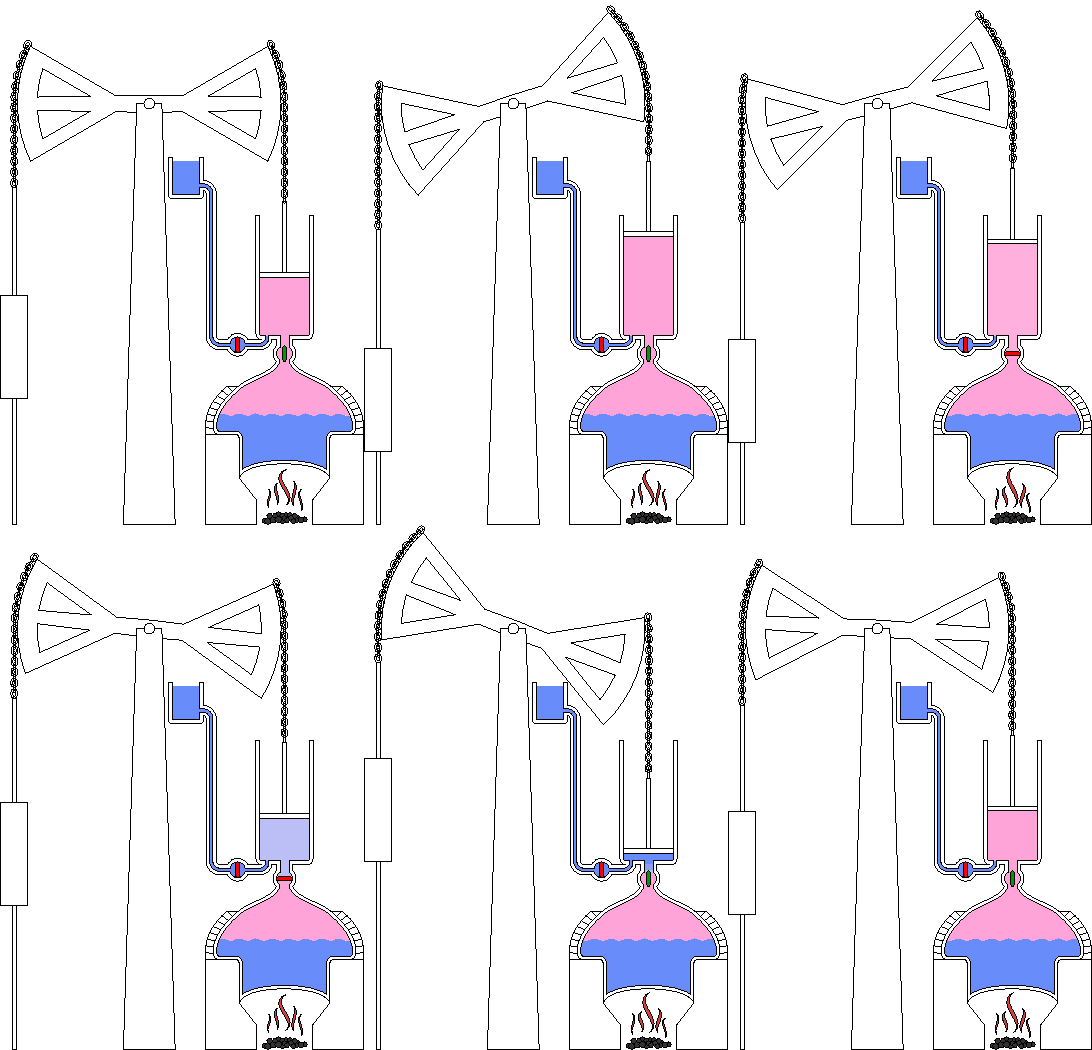
Its sole purpose was to pump water out of a mine. This was accomplished by pulling the rod on the left upwards. The water boiling in the lower right (blue) makes steam (pink) which moves into the cylinder above it allowing the piston atop it to rise, and the pump arm on the left to lower. When the piston reaches to top of the cylinder, a valve permits a small amount of water to spray into the cylinder, cooling and condensing the steam. Here’s the crucial point: when the steam condenses, the atmospheric pressure pushes the piston down, causing the pump arm on the left to rise. It is the condensation of the steam, not its expansion, that drives this steam engine.
The Newcomen engine suffered from a major design flaw that limited its power. In the 1760s, James Watt recognized the flaw and designed a better steam engine.
Other technologies were required, such as the technology for precisely boring cylindrical holes. The starting point for this was the early cannon. To build such a cannon, the gunmaker first selected a log of the desired size, then encircled it with long iron plates, then secured those plates with iron rings. This “core” was placed inside the mold, and then molten brass or bronze was poured into the mold. When the metal had cooled, the wooden log had burned and the iron plates and rings could be removed. This resulted in a thick-walled tube with rough inner walls. The gunmaker used a number of clumsy techniques to smooth the inner walls; the final result was pretty bad. It didn’t matter; cannons in those days fired stone balls that were not particularly smooth, either.
There were many experiments to improve upon this basic process, but progress was slow. The only real solution was to bore the inside of the cannon with a gigantic drill bit, but such a solution required the development of special drill bits and lathes and, especially, methods for keeping the hole being drilled absolutely straight. But accurate cannons were so important to military success that there was plenty of money to fund the many experiments and slow, incremental progress. It wasn’t until 1750 that a reliable system for drilling long, straight, smooth holes in metal was developed.
Other technologies were required to make steam engines practical: cam-driven valves for conducting steam from the boiler to the cylinder at exactly the right moment; centrifugal governors that regulated the speed of the engine; and improved boilers for distributing the heat from the coal furnace more effectively. among others.
A practical steam engine could not have been built without these and a number of other technologies.
Network effects trigger geometrically accelerating technological progress
Now I can make the first important point. Because technology enjoys the benefits of network effects, the more technology a civilization masters, the more technological opportunities arise. That in turn means that technological progress accelerates concomitantly with the amount of technology that already exists. The more technology you have, the faster you can create new technologies.
We have been experiencing this effect for centuries now, but only in the last century have we been able to directly experience it. In my lifetime, I have seen technology explode at an ever-faster rate.
Telephones
Let’s take telephones as an example. Here’s a rough chart showing the evolution of the telephone. As you can see, the basic design didn’t change much for nearly a hundred years, the only changes being simple matters of mechanical layout. In terms of operation, the first change was the number-dialing introduced around 1920; before that you first told the operator whom you wanted to call, and she made the connection. Around 1980 we saw the second significant change: the touch-tone dialing system. By 2000, we had cell phones, which had a huge impact. Then in 2007, we had the first smartphone; since then it has all but wiped out previous types of telephones.

Hence, most of the big changes have come in the last 20 years.
Computer resources
Now let’s talk about the improvements in computer technology. Here’s a quick-and-dirty graph showing how the overall power of the Macs I have owned over the years has increased.

Note that the vertical axis uses a logarithmic scale. Thus, the highest point on this graph (the iMac) is 19 orders of magnitude more powerful than my first Mac, the original 128K Mac. That’s ten quintillion times more powerful! (My formula for net power multiplies clock speed by RAM by hard storage by display RAM.)
How did we get such a stupendous increase in net power? It took a combination of many technologies to accomplish all this. First, there was the improvement in hardware, both CPU chips and memory chips. This required advances in a number of technologies, from the chip-making machines to the systems for establishing ever-cleaner fab rooms. That accomplished a lot. But to utilize all that increased hardware power, we had to make gigantic leaps in software design: memory management, operating system efficiency, multi-core management, and many other areas.
You may note that the curve slows down at the end. This is not geometric growth. This curve does not contradict my claim that technological progress always accelerates, because this is a single technology, not the entire technological state of human civilization. The fact is, personal computers are now good enough for my needs. A computer ten times faster and with ten times the storage would still be limited by the speed with which I can type and the amount of material that I have to write. If somebody discovered a process that made paper clips ten times cheaper, I doubt that people would buy more paper clips; they’re already so cheap that we don’t bother with using any more. This “perception of adequacy” limits the development of every product line. You don’t need a car that can go a thousand miles an hour, nor do you need a thousand cars. You can only eat so many hamburgers, play so many videogames, or read so many stupid essays on the Internet. You don’t need to heat your house to 100º in the winter, nor do you need to cool it to 0º in the summer. There are limits to human needs, and those limits constrain the number and kind of products we wish to own.
But technology changes, offering us completely new and different kinds of products. I never knew that I would want my own computer when computers were huge machines in basements; I didn’t know that I would want a smartphone when telephones were dial phones in the dining room.
Illumination
People have always wanted illumination at night. The history of illumination technologies shows standard acceleration. Here’s a table of the major technologies for illumination, with my best guess for the dates when they became commonly used.
Fire 1.9 million years ago
Bare oil lamp 4500 BCE
Candle 3000 BCE
Candle with wick 500 BCE
Kerosene lamp 1870
Incandescent light bulb 1900
Flourescent light bulb 1940
LED light bulb 2000
I placed a gap between the candle with wick and the kerosene lamp, because the last four sources of illumination came in just 130 years, while the first four sources occupied a huge stretch of time. As you can see, the technology of illumination showed quite a lot of acceleration.
Another long-lived technology that showed dramatic expansion recently is the technology for writing. Here are major writing tools, along with the dates they became commonly used.
Cuneiform reed stylus 3000 BCE
Reed ink pen 700 BCE
feather quill pen 600 CE
pencil 1550
steel pen 1822
fountain pen 1884
ballpoint pen 1938
felt tip pen 1962
rollerball pen 1970
gel pen 1980
Again we see the long hiatus between the ancient technologies and modern pen technologies. The technology accelerated because other technologies made possible new designs.
There are lots of other examples of technological progress from history. I have used relatively recent ones, but we have similar trajectories for a wide range of technologies: airplanes, cars, metallurgy, chemistry, medicines — almost every field of technology has its own impressive trajectory showing the same acceleration of progress with time. The only technologies that have shown little improvement are those that fully satisfy our needs. We haven’t seen any advances in paper clip manufacturing for a long time.
The Sorcerer’s Apprentice
This may all sound like one of those paeans to “The March of Progress” boasting of the glories of science and technology: “Every day in every way, better and better!” It isn’t; the acceleration of technological progress inevitably drives a civilization to its doom. Here’s one way to visualize the nature of the problem. First, let’s make a sketch graph of technological progress for some civilization somewhere in the galaxy:
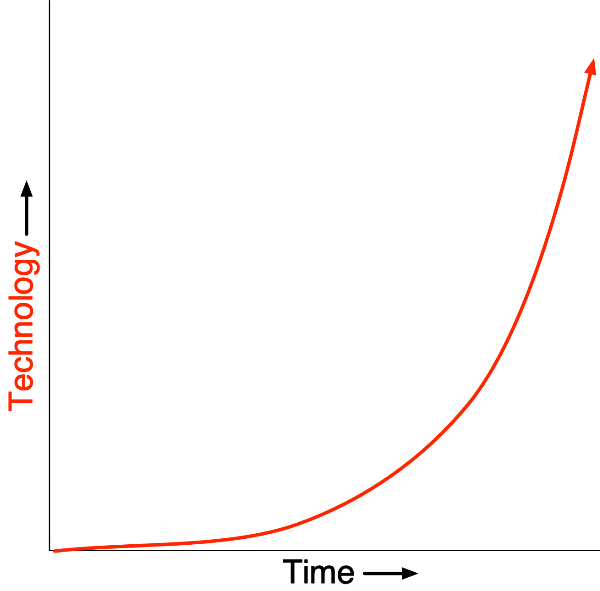
This is simply a standard geometric growth curve, the result of the geometrically accelerating progress of technology. But now let’s consider the fact that technological progress always creates change, change that a civilization must learn to adapt to. All change creates social stresses because a society adapts to its situation, and change renders some aspects of the organization of that civilization ineffective. In terrestrial civilization, for example, the Industrial Revolution imposed huge stresses upon society because it changed how society functioned. We all know about the efforts of the Luddites to destroy the machines that were ruining their lives, but there were many other stresses. Industrialization combined with the railroad profoundly changed military realities, but the American Civil War was a bloody muddle with stupendous unnecessary casualties because the generals of those times had been brought up under different conditions and simply didn’t know how to lead an army in the new military realities. It took over a hundred years for Western societies to iron out the complex new relationship between labor and the owners of factories.
The underlying principle that causes so much trouble is the learning curve that every individual experiences while maturing. In the first half of our lives (say, to age 40), we learn about our world and how all the pieces fit together. Having learned all that, in the second half of our lives, we gain the power to influence society, using what we have learned.
This means that, very roughly speaking, the speed with which a society can change to adapt to new realities is equal to some fraction of an individual’s life, let’s say half a lifetime. Here on earth, with an average life expectancy of maybe 80 years, the time it takes a society to adapt to new realities is therefore — very roughly — about 40 years. To put it another way, at any given time, our society is best adapted to the reality of forty years ago.
Now, we can argue endlessly about the correct time lag between the appearance of a new technological reality and the society’s adaption to that technological reality, but there’s no question that the time lag exists. So let’s assume that a society always adapts to new technological realities after some time lag. Let’s graph that:
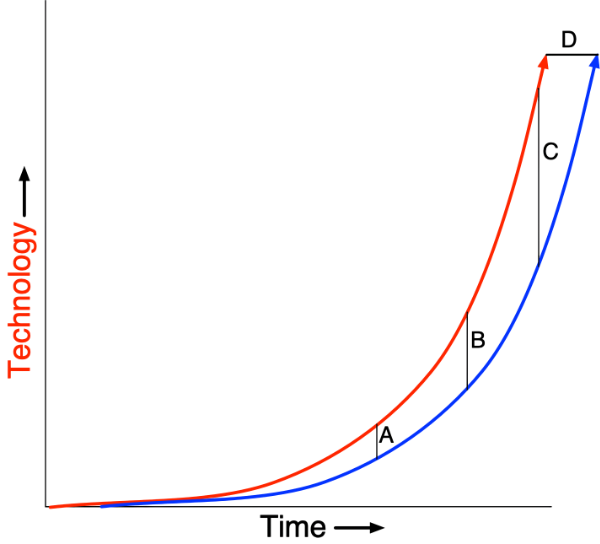
The red curve is the same progress of technology that I graphed above. The blue curve represents the adaptation of a civilization to technological progress, assuming a time lag shown by the line segment “D”. The line segments A, B, and C represent how far behind the technological reality the civilization falls with the passage of time. The point of this graph is that the civilization inevitably falls further and further behind the technological reality. This leads us to the whole point of this essay: the every civilization must inevitably fall so far behind its technological reality that it can no longer cope with technological change. This must lead to the collapse of the civilization.
Another possible cause of lag
The previous analysis relies on the assumption that a civilization always lags behind change by a fixed amount. There are many other possible ways to estimate the time lag. Another assumption we could make as to the cause of lagging adjustment to change is that society as a whole has a fixed rate of change in response to external stress. Under this assumption, society always needs a fixed number of years to adjust to a new stress. This assumption, in my opinion, more closely fits human nature and yields even stronger results. That assumption is that individuals have an upper limit to their ability to cope with change. The 20th century put more change-stress on people than the 19th century did, and the 21st century is already putting more change-stress on people than the 20th century. To put it another way, we have seen more technological change between 2025 and 2000 than was experienced between 2000 and 1900. That’s because technological progess has accelerated.
My own experience, and that of most of the old geezers I know, is that the world of 2025 is so different from the world in which we grew up that we no longer attempt to keep up with all the change. I don’t even try to figure out how to access all the features of my new Super-Duper Turbo-Charged Quantum television. I have learned only the most basic functions. The same applies to my iPhone, most of the software on my computer, and my car. There’s just too much stuff to learn, and I don’t have the time to learn it. I just hope that they don’t change refrigerators and microwave ovens too much, lest I starve amidst all this super high technology.
So let’s assume that the ability of a civilization to adapt to change is linear. It can only change at a fixed rate (We math-geeks call it “linear change”, as is obvious from the graph). This yields the following red-blue graph:
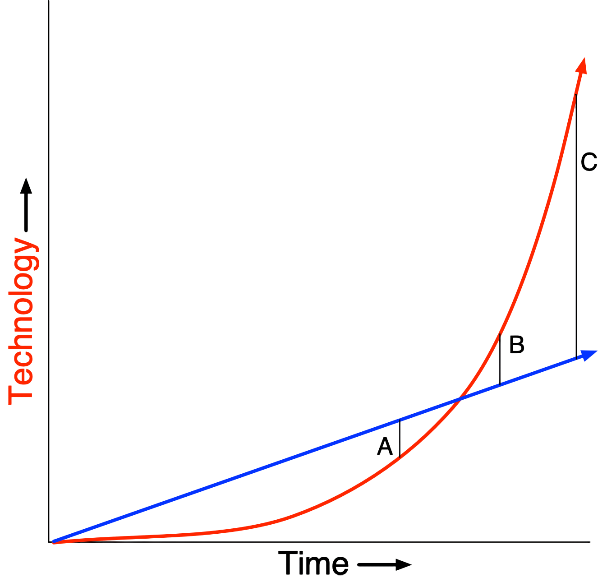
In this graph, the civilization can easily handle technological change in its early times. Such was the case on earth during, say, Roman times (A), because technological change was so slow that nobody noticed it. However, at a certain point, the red curve crosses over the blue line, at which point the civilization can no longer keep up with technological change. At first (B), this is not much of a problem, but the magnitude of the problem grows with the passage of time. Once again we come to the conclusion that the civilization must inevitably fall so far behind its technology that it can no longer cope, and will surely collapse.
I can prepare graphs based on other assumptions, but the underlying principle is constant: if you have geometrically growing technology, at some point, it MUST exceed the capacity of the society to cope with change, because no civilization can change as fast as technology can change.
Empirical evidence from earth
Our own experience here on earth demonstrates the operation of this principle, as we are now at the crossing point where our technology is exceeding our ability to cope. Examples:
Nuclear weapons
In the early years, when only a handful of nations (USA, USSR, France, UK) possessed nuclear weapons, humanity did a fairly good job of containing them with the Test Ban Treaty and the Non-Proliferation Treaty, and the various arms limitations treaties culminating in the reduction of offensive nuclear weapons to just 1,500 warheads per country. However, the weapons began to spread: China 1964; Israel 1967; India 1974; Pakistan 1998; North Korea 2006. Iran has been developing the capability to build nuclear weapons and the American attack on Iranian nuclear facilities in June, 2025 drove home the point that nuclear weapons were the only effective defense upon which Iran or any other country could rely. At this point, it is only a matter of time before nuclear weapons become more broadly available; it is all but a certainty that they will be used later in this century. It is not a certainty that there will be a full exchange of nuclear weapons between nuclear powers, but the risk increases each year.
Climate change
For forty years, we have known of the likelihood that our carbon emissions would change our climate in destructive ways; a scientific consensus that climate change was real and dangerous was reached by the year 2000; since then, humanity has made some half-hearted efforts to reduce the impact of climate change. Some nations, especially in Europe, have made substantial efforts to reduce their carbon emissions, but the federal government of the USA denies the existence of any problem and has slashed funding of all efforts to address the problem. China has made some measures, but remains the greatest emitter of carbon on the planet. Meanwhile, the damages from climate change grow by the year. Currently, average annual damages from climate change in the USA amount to roughly $300 billion, depending upon how it is measured. Global average annual damages amount to at least $1 trillion. These damages are calculated to rise dramatically in the next 25 years, reaching economically punishing levels by 2050.
The true threat from climate change, however, is neither economic nor physical; it is geopolitical. Here’s one possible scenario demonstrating just how dangerous climate change is. It begins with the fact that climate change will inflict huge damages on poor nations that are unable to defend against it. Pacific island nations such as Kiribati, Tuvalu, and the Marshall Islands will likely become uninhabitable by 2050. Millions of other people along low-lying coasts will be forced to move. These climate refugees will need to be relocated, and many nations will demand compensation from the USA, because the USA has, historically, emitted the greatest amount of carbon, and because it has been the biggest obstacle to international efforts to reduce the damage from climate change. They will also demand that the USA accept a goodly portion of climate refugees. Given the recent treatment of illegal aliens by the federal government, I think you can guess the likely reaction of the USA to demands to accept climate refugees, and it’s also unlikely that the USA will be willing to provide anywhere near the compensation demanded by the worst victims of climate change.
Enter China, which has been positioning itself as the champion of poor nations all across the world. China will assume the position of leader of the victims of climate change, and add heft to their demands for compensation and resettlement. The USA will, of course, reject these demands, relying on its military power to defend itself. China will then organize an economic embargo by the coalition it has built. Such an embargo would cripple the American economy. I would expect the USA to respond with a military invasion of a convenient target, or perhaps bomb the capitals of a number of these weak nations. That’s when China steps up and provides its own military protection to these nations. The USA, feeling cornered and desperate, resorts to increasingly violent measures, and the situation spirals all the way down to nuclear war.
This is only one scenario; there are many variations on this scenario with equally dire outcomes. The key point to learn is that climate change imposes different costs on different countries, which in turn creates geopolitical conflicts that we are ill-suited to cope with.
Internet collapse
The Internet has revolutionized our lives. In just a few decades, we have reorganized our society to take full advantage of it. The Internet has all but replaced physical mail, and bank checks. Most people now get their news (sad to say) from the Internet. Television viewership goes down as streaming goes up. People are using cash less and less. Millions of people work from home because of the Internet. Our lifestyles have changed dramatically due to the Internet.
Imagine the havoc that would ensue should some maleficent agent figure out how to disable the Internet. I very much doubt that we could cope with such a catastrophe without suffering stupendous economic damage. Fingers would point in a thousand directions and anger would dominate public discussion. And thousands would die without their daily supply of cute cat videos.
Biotechnology attacks
The rapid developments in biotechnology and AI have opened the possibility of a maleficent agent developing a virus that is both highly contagious and often fatal. Such a disease could kill billions of people, with catastrophic consequences for civilization at large. We might comfort ourselves with the realization that such a technology would render nuclear weapons obsolete — until we remember that this is only because such a weapon would be far cheaper and deadlier than any nuclear weapon.
Even with the best of intentions, biotechnology could inadvertently kill millions. It is likely that this has already happened; the most favored hypothesis among scientists is that the Covid-19 virus escaped from an experimental station in a laboratory in Wuhan, China, killing something like 14 million people.
Gini
The Gini Index is a measure of inequality of income. In a society in which everybody has exactly the same income, the Gini Index is 0; in a society in which one person gets everything, the Gini Index is 1.0. The most equal countries in the world, such as the Netherlands, the Czech Republic, Iceland, and Belgium, have Gini Indexes around 0.25. Many of the other European countries come in around 0.30. Countries like China, Russia, and Iran, are around 0.35. The United States has a Gini Index of 0.42. The most unequal countries in the world have Gini Indexes around 0.50. In these countries, most of the wealth is enjoyed by the very rich.
We can argue about whether this is right, or fair, or proper. What we cannot argue about is that people deeply resent inequality. This is not just something we are socialized to believe; it is burned right into our genes. Many mammals have been found to resent unequal treatment. To see just how serious this is, watch the following 3-minute video:
https://www.youtube.com/watch?v=meiU6TxysCg
It’s important that you watch this video, because I’ll be referring to it later.
The point I am making is that humans have an instinctive expectation of being treated just as well as the next guy. So what happens when the median American worker with a $60K annual salary learns that their CEO takes home about $19 million — over 300 times what the median worker earns? A grape isn’t 300 times better than a slice of cucumber — do you think that the worker’s reaction might be even angrier than what you saw in the video?
Here’s a history of the value of the Gini Index in America since 1960. As you can see, it steadily fell during the 1960s and 1970s, bottoming out in 1980. During the Reagan years, it rose steeply and has continued rising ever since. This is partly due to changes in tax polices by Republicans, who have cut the effective tax rate on the wealthy down to a value just a tad higher than the effective tax rate for the middle class. They have all but eliminated what’s called “progressive taxation”, which imposes higher tax rates on the wealthy.

You can find an excellent summary of American wealth inequality on Wikipedia:
https://en.wikipedia.org/wiki/Income_inequality_in_the_United_States
As with all Wikipedia articles, the real meat lies in the footnotes providing primary source material; over 300 such footnotes accompany this article.
Land, labor, and capital
Don’t be quick to blame evil capitalists for this problem. While it’s true that the wealthy now control much of the government in America, there is an underlying economic trend that would have done much the same without the actions of the wealthy. Perhaps you recall from your high school economics class (they DO still teach basic economics in high school these days, don’t they?) that the three fundamental sources of wealth are land, labor, and capital. They don’t tell you that the relative importance of these factors has changed over time. In olden times (before the Industrial Revolution), land was far and away the primary source of wealth. The people who owned land (aristocrats) controlled most of the wealth.
The Industrial Revolution changed that, shifting much of the economic productivity to labor. This forced a profound change in economic relationships. It took a hundred years to work out, but by the early twentieth century, labor was gaining a greater share of the wealth, and by mid-century, played a crucial role in the economy, thereby gaining a much larger portion of the wealth.
But late in the twentieth century, another profound shift began. Machines began playing an ever more important role in overall economic productivity. Industrial robots began replacing labor, and then computers began replacing people in many other roles. Does anybody remember an occupation called “travel agent”? You told them where you wanted to go and how much money you were willing to spend, and they would arrange airplane tickets, hotels, car rentals — whatever you needed. For their efforts, they took a percentage of your expenditure. Nowadays travel agents have been replaced by computers running websites such as Expedia. The computers are cheaper, faster, and better informed than any travel agent. This has been happening all over the economy. In the process, all these machines have lowered the cost of just about everything, delivering much better products and services to people at lower prices.
But something else changed. When people did that work, part of the profits so generated went to pay the workers. But when machines replace people, the profits go to the owners of the machines. We use the term “capital” to include all the investment that goes into a business: the machines, the buildings, the electricity, and so forth. In other words, nowadays the profits go not to workers (there aren’t many), but to the owners of capital. Who owns capital? Rich people. Therefore, more and more wealth is going to the people who are wealthy. The old adage is truer now than ever before: the rich get richer and the poor get poorer.
Inequality creates social and political stress
The monkey who was cheated threw the cucumber at the scientist; what do you think that people who are cheated will do? The answer is already apparent: they get really angry. Their problem is compounded by the fact that they don’t know exactly how or why they are being cheated. They just know that they’re being cheated. Situations like this are easily exploited by ruthless politicians who offer simple solutions to the suffering of the masses: direct their anger towards scapegoats. Blame their troubles on Jews, or Mexicans, or illegal immigrants who are eating your pet dogs and cats, or intellectuals (a common target), or liberals, or activist judges, or SOMEBODY. People have difficulty understanding economics and tax policy, but they easily grasp the significance of “The Bad Guys” and the clarity of the solution to their problems: “Get those Bad Guys!”
This process has been acting out all over the developed world. In Britain, it was the unelected bureaucrats of the European Union, so Britons voted to leave the EU, an economically idiotic decision. In Hungary, they went for Victor Orban, another populist autocrat who blamed Bad Guys to gain control of the country. We’ve seen rightward shifts in Italy, now led by Giorgia Meloni, a rightwing politician; Turkey (Recep Tayyip Erdoğan); Israel (Benjamin Netanyahu), India (Narendra Modi) and of course, the USA (Donald Trump). We’re seeing rightwing populist parties growing in power in Germany (the “Alternative for Germany” party); France (the National Rally); Spain (Vox); Poland (Law and Justice); and Portugal (Chega). There are right-wing populist political parties in just about every democratic nation in the world, and many of them are growing in power.
We are seeing the same process taking place all over the world, in many different countries with different social and political structures, different religions, different levels of wealth. About the only countries in which this isn’t happening are the countries that are already dictatorships. Why is this shift towards angry xenophobic and autocratic political parties taking place everywhere?
It’s because our technological progress has shifted economic output from labor to capital, impoverishing the working classes and enriching the wealthy. But we are just beginning a long process that ultimately leads to disaster. The great historian Will Durant wrote many years ago:
“Since practical ability differs from person to person, the majority of such abilities in nearly all societies, is gathered in a minority of men. The concentration of wealth is a natural result of this concentration of ability, and regularly recurs in history... In progressive societies the concentration may reach a point where the strength in number of the many poor rivals the strength of ability in the few rich; then the unstable equilibrium generates a critical situation, which history has diversely met by legislation redistributing wealth or revolution redistributing poverty.”
Resolution of the Fermi paradox
While I was in grad school in the 1970s, I gave a lecture every Friday night on some astronomy topic. One evening I gave a lecture entitled “Why aren’t we knee-deep in little green men?” I began by walking the audience through the common calculation used to demonstrate the high probability of intelligent life elsewhere in the universe. Our galaxy has about 200 billion stars. If only 1% of those stars have planets, then there are 2 billion stars with planets. If only 1% of those planets develop life, then there are 20 million planets with life on them. If only 1% of those planets develop intelligent life, then there are 200,000 civilizations on the planet. And if only 1% of those civilizations reach the stage where they could travel between the stars, then there would be 2,000 starfaring civilizations in our galaxy.
But there’s more. Our galaxy is more than 10 billion years old, whereas our solar system is only about 4 billion years old. That means that there would probably be lots of starfaring civilizations that came along billions of years before us. Now, even if such a civilization could travel at only 1% of the speed of light, they could reach other habitable systems in a few thousand years. If it took a thousand years to fully colonize a new planet, they could move on to the next star system after that, meaning that they could populate the entire galaxy in less than 100 million years. And since there are probably several thousand such civilizations, the odds are that the galaxy has already 8been fully colonized by at least one of them.
So why aren’t we knee-deep in little green men, I asked rhetorically. There is no good answer, I answered. The best answer I could come up with is that no civilization in the galaxy, over billions of years, has ever reached the point where they could engage in interstellar travel. That was the conclusion of my lecture.
A few years later, I discovered that I wasn’t the first person to figure this out. The great physicist Enrico Fermi first reached this conclusion in 1950. (Odd side note: after graduating from high school, I got a summer job working for a professional gardener who cared for the properties of rich people, one of whom happened to be Mr. Fermi. I never saw the great scientist, but I knew who he was as I mowed his lawn.)
You can find more information about the Fermi Paradox here.
Conclusion
I have presented many examples from earth history, but these are only one example of how the stresses caused by accelerated technological progress can tear apart a civilization. The fundamental principles I describe are not dependent upon the specifics of the terrestrial environment; these principles apply anywhere in the universe:
1. The more technology a civilization possesses, the faster its technology increases.
2. Therefore, technological progress always accelerates faster and faster.
3. Intelligent creatures are optimally adapted to their environment; they have a limited capacity to cope with changes in that environment.
4. The combination of #2 and #3 means that every civilization must inevitably evolve to the point where it can no longer cope with its technology.
5. When that happens, the civilization destroys itself.
6. The species need not go extinct when its civilization is destroyed; it can simply revert to an earlier, simpler state of technological development.
7. This line of reasoning resolves the Fermi Paradox.
Supporting essays:
Future Shock
Necessity of Adaptation
Capacity for Change
Refutatio
The Second Law of Thermodynamics
Indicators of When the Collapse Will Take Place